Your Cart is Empty


Calm without the fog is a hard thing to find in a capsule. Many people take L-theanine for exactly that reason, hoping to feel settled and clear at the same time. The catch is that one bottle can differ wildly from the next, and the label rarely makes it obvious.
Choosing the best L-theanine supplement really comes down to three things: how much you get per serving, how pure it is, and how well it was made. Get those right, and the rest falls into place. BioNeurix builds calm-focused, quality-tested formulas around that same standard, which makes the checklist below a useful place to start.
Dosage: Look for 100 to 200 mg per serving, the range covering most research, and start at the lower end to see how your body responds.
Purity:Choose a product that is third-party tested, ideally National Sanitation Foundation (NSF) certified, with a transparent label listing the exact mg per capsule and few unnecessary fillers.
Quality: Favor a standardized, patented form like Suntheanine, made in a current Good Manufacturing Practices (cGMP) certified facility that proves its quality rather than just claiming it.
Seredyn Complete Calm combines L-theanine with passion flower, valerian, niacinamide, and magnesium taurinate in one calm-focused formula.
See Seredyn Complete Calm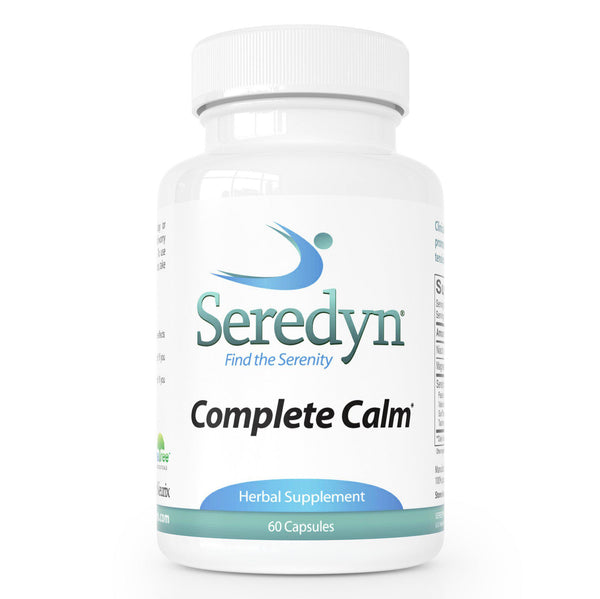
L-theanine is an amino acid that supports a relaxed, focused state without the heavy, sleepy pull of many calming products.² It works gently, which is a big part of why people reach for it during a busy day rather than only at night.
L-theanine is a naturally occurring amino acid found mostly in tea leaves, particularly green tea and, to a smaller degree, black tea. The body does not build proteins from it the way it does with some other amino acids. Instead, it is valued for how it affects the way a person feels, which is why it shows up so often in dietary supplements aimed at calm.¹
Research links L-theanine to alpha brain wave activity, the pattern the brain tends to show during quiet, wakeful rest.³ That connection helps explain the calm focus many people describe: settled but still sharp. People often take L-theanine to promote relaxation and support cognitive function during stress, without the drowsiness that can come from stronger sleep aids.

A quality L-theanine product proves itself on the label, not in the marketing. The difference between a strong formula and a weak one usually comes down to a handful of checks anyone can make before buying.
A few markers separate a well-made product from a weak one:
Third-party testing that confirms purity and the exact amount per serving, ideally from a National Sanitation Foundation (NSF) certified lab
A standardized, patented form of L-theanine, such as Suntheanine, for consistent potency
A transparent label listing the exact mg of L-theanine per capsule
Manufacturing in a cGMP-certified facility that is rigorously tested for quality
Few or no unnecessary fillers, binders, or artificial additives
Run a bottle past that list, and its quality stops being a guess. A product that hides its dose or skips independent testing is asking for trust it has not earned.
If you want L-theanine alongside other calming ingredients, Seredyn Complete Calm brings several complementary ingredients together in one formula.
View the FormulaMost L-theanine supplements land between 100 and 200 mg per serving, and that range covers much of the available research.⁴ The dose matters as much as the ingredient itself, since a bottle with too little gives the body little to work with.
Most products and studies fall in the 100 to 200 mg range, and starting at the lower end is a reasonable way to see how your body responds. Starting low and adjusting up is usually better than jumping straight to the top of the range. Anyone pregnant, nursing, or taking medication should check with a healthcare provider before starting any supplement, since individual needs vary.
When to take L-theanine depends on what you want from it. Some reach for it during stressful stretches to support relaxation while staying alert, since it does not tend to cause drowsiness. Others take it in the evening as part of good sleep hygiene, hoping to wind down and fall asleep more easily. Neither approach is wrong; the right one is the schedule that fits the goal.

Both a single-ingredient capsule and a multi-ingredient blend have a place, and the better pick depends on the routine you want. A standalone dose keeps things simple and precise. A blend layers L-theanine with other calming ingredients so one capsule covers more ground.
Blends often combine L-theanine with other calming ingredients, such as:
Magnesium
Niacinamide
A blend tends to appeal to anyone who wants more than one calming ingredient without swallowing several separate pills. That convenience, paired with a transparent label, is what makes a well-built combination worth a look.
Choosing well is not complicated once the priorities are clear: confirm the dose, check that purity is third-party tested, and judge the overall quality of how the product was made. Those three checks turn a crowded shelf into a short list.
For anyone leaning toward a blend, Seredyn Complete Calm from BioNeurix pairs L-theanine with passion flower, valerian, niacinamide, and magnesium taurinate in one capsule, made under cGMP standards to support a calm, relaxed state.
Choose a formula that meets the standard, and let everyday calm start there.
If a blended formula fits your routine, take a closer look at Seredyn Complete Calm, its ingredients, and how it may fit your everyday calm routine.
Check Seredyn Complete CalmMany people notice a sense of calm within an hour of taking L-theanine, though timing varies by person based on dose and body chemistry.
L-theanine is widely used as a daily supplement and is generally well tolerated, but it's always smart to check with a healthcare provider before starting a daily routine.
Yes, L-theanine and caffeine are a common combination, and many people find that L-theanine smooths out caffeine's jittery edge while keeping focus.
L-theanine supports relaxation without the strong drowsiness of many sleep aids, so most people can take it during the day without feeling foggy.
The best time depends on your goal: daytime doses support calm focus, while evening doses fit a wind-down routine before sleep.
Dashwood, R., & Visioli, F. (2025). l-theanine: From tea leaf to trending supplement - does the science match the hype for brain health and relaxation?. Nutrition research (New York, N.Y.), 134, 39–48. https://doi.org/10.1016/j.nutres.2024.12.008
Evans, M., McDonald, A. C., Xiong, L., Crowley, D. C., & Guthrie, N. (2021). A Randomized, Triple-Blind, Placebo-Controlled, Crossover Study to Investigate the Efficacy of a Single Dose of AlphaWave® L-Theanine on Stress in a Healthy Adult Population. Neurology and therapy, 10(2), 1061–1078. https://doi.org/10.1007/s40120-021-00284-x
Nobre, A. C., Rao, A., & Owen, G. N. (2008). L-theanine, a natural constituent in tea, and its effect on mental state. Asia Pacific journal of clinical nutrition, 17 Suppl 1, 167–168. https://pubmed.ncbi.nlm.nih.gov/18296328/
Williams, J. L., Everett, J. M., D'Cunha, N. M., Sergi, D., Georgousopoulou, E. N., Keegan, R. J., McKune, A. J., Mellor, D. D., Anstice, N., & Naumovski, N. (2020). The Effects of Green Tea Amino Acid L-Theanine Consumption on the Ability to Manage Stress and Anxiety Levels: a Systematic Review. Plant foods for human nutrition (Dordrecht, Netherlands), 75(1), 12–23. https://doi.org/10.1007/s11130-019-00771-5